Sunday, 22 March 2009

Le Feu Follet (Malle, 1963)

I was a bit at odds with what to watch last night, torn between '5x2' by Francois Ozon and this film (Le Feu Follet) by Louis Malle.
In the end I chose Le Feu Follet because it had a prettier name, and I could sort of remember what it was about without having to google it, or bang it into the ever reliable 'resource' of Wikipedia.

Le Feu Follet follows the story of Alain Leroy, a recovering alcoholic who decides to end his life. The film follows him on his last few days in Paris and the surrounding areas, as he visits his friends, trying to find a reason to carry on living.
The film is shot in black and white and adds to the starkness and depression that Alain is suffering from, seeing his world (which spans to one room when he is not visiting friends) in black and white not only adds to the depression he is feeling, but also seems to draw lines or barriers between things that are not normally noticeable.
The barrier between Alain's girlfriend in a taxi and Alain is more noticeable for instance, not only because of their separation in the frame, but Alain's reluctance to travel to New York with her.

The next morning Alain calmly narrates 'Tomorrow I'll kill myself', which at the time seems like a very 'off the cuff' remark, but as we explore his world and his relationships with other characters we can see that he really has nothing enjoyable left to live for.

Thursday, 5 March 2009

The Beach

The Beach (Boyle, 2000)

The Beach is a film based on the novel of the same name by Alex Garland. The film follows a young American; Richard, travelling around Thailand. In his travels he meets Francoise and Etienne, a French couple, whom he travels to a mysterious island with. The island (and the ‘beach’) was first mentioned to him by Daffy, an unhinged Scotsman who leaves a copy of a map to the beach to Richard after his suicide, Daffy reappears to Richard in various hallucinations throughout the film.

The film is fully narrated by Richard, and we hear his thoughts and feelings while we travel with him. The film addresses issues concerning western and eastern cultures and how they can combine and clash, issues of identity and ‘paradise’ are also raised during the film, as well as man versus nature. The Beach also blurs the line between a ‘mainstream’ Hollywood film and an ‘art-film’; using techniques from both to entertain and inform the audience of the narrative. Bordwell notes that “Art-cinema narration has become a coherent mode partly by defining itself as a deviation from classical narrative” (Bordwell, (1985), p228), The Beach can be classed as a ‘Hollywood’ narrative; it follows a linear pattern and never really deviates from its main subject, Richard. The one thing that sets it aside from other Hollywood narratives is the characterisation of the protagonists. The characters appear to be similar to art cinema characters. Richard, the main character, is unsure of what he wants; the beach, Francoise or both. This goes against Bordwell’s notion of ‘classical narration’ in Hollywood cinema; the protagonist is usually the causal driving force, the primary source of identification for the audience and the source of narrative. (Bordwell, (1985), p.157) although Richard is the primary character, he does not conform to the Hollywood ‘leading man’ stereotype; he is unhappy and has no direction, the narration he provides over the scenes also makes the thoughts and feelings he experiences much more obvious to the audience, expressing his negativity and lack of direction. Kristin Thompson claims that “Hollywood protagonists tend to be active, to seek out goals and pursue them, rather than having those goals thrust upon them” ((1999) p.14). Richard is the exact opposite to this definition of Hollywood character; he is unaware of his goals or what he wants. Until given a task by Sal to get back the map from the surfers, Richard has had no ‘goals’ other than getting to the island, even at the end of the film, Richard and the islanders are told to leave by the farmers, rather than making the decision to move away from Sal’s dictatorship of their own accord. The characters in The Beach and in ‘Art Cinema’ are far less goal oriented than their Hollywood counterparts; the narrative in the film is pushed forward more by the characters’ development than cause and effect in general, or alternatively one could say that the ‘cause and effect’ is initiated by the characters; e.g. Richard leaves the map and the American surfers follow him to the secret island, which causes the inhabitants of the island to leave, rather than the cause being a problem and the effect being how to solve the problem. The idea of ‘the beach’ is also similar to an ‘art cinema’ storyline, the whole island is bathed in mystery, neither the audience or the characters know if it exists or is totally make believe, the film is more about personal discovery than a battle to save the island or to get the girl.

The first scene opens with a shot of Richard sitting on a bench bathed in white light. Above him are several numbers running along the top of the screen. The opening shot almost looks like film from a negative photo, enforcing the fact that Richard comes from a digital, technological culture. The differences between traditional eastern cultures and western cultures are highlighted when compared with the next image; the golden image of Buddha lying on its side, bringing the traditional culture of Thailand into the film, only to ignore it later in the westernized Thai market place, and throughout the film in general. While Richard is in front of the white light, people and vehicles blur past him, but when in front of the image of Buddha the cars and people seem to move a lot more slowly, reinforcing the cultural differences.
The opening scene also enforces the fact that we know nothing about our narrator, whether he is reliable, where he comes from or where he is going. The first time we see Richard he is in negative, the first lines he speaks are: “My name is Richard. So what else do you need to know? Stuff about my family, or where I'm from? None of that matters.”
The first scene establishes that we are on a journey as well as the characters, a journey of discovery about them; who they are, what their aims are and what they will do to get what they want. The voice over by Richard helps to impose the idea of travelling into the unknown without any plan or regard for consequences, or with people we trust.
Much like the characters of ‘art cinema’ the three main characters of The Beach are on a journey of self discovery, rather than to change or acquire something. This is apparent throughout the film, rather than ‘cause and effect’ being the main catalyst for plot and narrative, the characters cause the events, and have to deal with the effects. Richard seems to fulfil the roles of protagonist and antagonist by himself, supplying the map to American surfers Sammy and Zeph, and then assisting in getting them shot by the marijuana farmers, again blurring the lines between traditional Hollywood cinema and ‘Art-Cinema’ stereotypes. His character traits are also not what you would expect to find in leading man; he lies several times throughout the film to get out of trouble. He lies to Sal about the map several times and to Francoise about sleeping with Sal. The Beach also brings up questions about morals and the idea that they can be lost. When Christoph is bitten by the shark no one wants him in the camp and he is banished to the forest to die. The only person who maintains their moral grip on reality is Etienne, who stays with Christoph and looks after him, the rest of the tribe don’t want to be reminded of death or have their fun spoilt.

The scene in the market could be considered a typical technical ‘Hollywood’ scene, and is very much in keeping with the Hollywood traditions enforced and used in the film.
Another aspect of the film to consider is the major ‘star’ and the studio’s productions values. Leonardo DiCaprio is the major star of The Beach and at the time was a rising star in Hollywood; giving the film more publicity and added mainstream attention. The controversy surrounding the actual construction of ‘the beach’ also should be considered; the production company changed the landscape of where the film was set to make it a ‘paradise’, without considering the effects on nature, natural wildlife or the inhabitants. This factor should be considered when analysing the film’s themes and motifs; the idea of leaving your ‘old life’ behind and travelling somewhere to start a new life in ‘paradise’ like the island or the beach, without considering the implications of what you are about to do, or the effect cultures have on each other and how they can clash or blend together. The Thai market scene is a good example of how two cultures can mix and collide. Original Thai traditions are kept to back alleys, where as the western consumerist attitudes are thrust upon travellers, the traditional cultural aspects of Thailand like religion and the New Year celebrations have to make concessions for Western rituals like shopping, drinking and television. The use of a steadi-cam is allows us to fully explore the market, giving the audience the feel of the hustle and bustle. It also employs bright fluorescent lighting which is totally opposed to the shot of the Buddha lying down in the opening scene, the lighting in the scene almost gives the Buddha a golden glow and there is no hustle and bustle, the smooth tracking shot following Richard seems peaceful and serene, much like the image of Buddha, again enforcing the cultural traditions of Thailand. The traditions are forgotten when Richard arrives in the market, and the only mention of Thai culture is the celebration of the New Year with water, (although, this is only made clear in the deleted scenes), the rest of the market appears heavily westernized, and as Richard narrates he comments on the market, saying that you could pick up cheap knock offs and counterfeit watches of a westernized culture. Traditional cultural customs are kept in back alleys away from ‘tourists’, like the ‘snake blood’ sequence, and the attitude of the inhabitants of the secret island in general; they want to keep part of their culture hidden and undiluted by the tourists, this is further emphasised when we meet Daffy, who calls the guests at a hostel ‘parasites’ and ‘cancers’, referring to their tourist status, although they are just the same as the people living on the island.
The idea of a western culture consumerism remains on the island; it is shown when Richard collects shopping for the inhabitants when he goes with Sal to Ko Pang Yang. In the beginning scene Richard asks what the point of travelling across the world to check into a hotel will all the comforts of home is, and then when arriving back at the consumerist Ko Pang Yang, he collects things to make the inhabitants back on the island more comfortable, the reliance of their old lives making an impact on their new lives on the beach. Preconceptions about island life are also used; when Richard arrives he thought the island might be people living in relative squalor, in a cave or in mud huts or tents. This idea is further enforced when we first meet Keaty after the dive into the lagoon under the waterfall; he fulfils every stereotype of an Amazonian male warrior, but speaks with an English accent, bringing to our attention the different mix of cultures and languages that could be apparent on the island as well preconceptions about peoples lives before they arrived on the beach.
Languages are also an important part of the The Beach, in one scene in the hut the villagers are trying to learn a language from the large pool of different languages available (“I will ride for many miles on my bicycle tomorrow”). Languages are used to communicate in The Beach, and also to hide behind. When Swede Christoph has been bitten by the shark he reverts back to speaking Swedish, even though in many scenes we have seen and heard him talking English, he hides behind his language hoping that it will get him back to the mainland.

Colour is used a lot during the opening of The Beach; when in the market place, the lights surround Richard as he walks through, some of the colours are used as signifiers; when talking to the ‘snake-blood’ trader, both men are bathed in red light, possibly indicating danger. Red is used significantly throughout the film, the snake blood scene, the use of blood and the tent Christoph is banished to are all red, the use of red stands out because of colour of the beach and its surrounding, mostly greens, blues and browns, the use of red usually brings connotations of danger or blood. At the mainland when the surfers approach Richard they are bathed in red light, possible indicating a future event. Richard steals a red headband from one of the farmers, referencing Rambo, but also letting his presence in the jungle known to the farmers. Richard assumes the dominant male position in the community by killing a shark, as he tells the story through flashbacks; he is covered in the shark’s blood. Sal also frequently wears something that is coloured red.
After the shark attack on the beach red is a much more prominent colour throughout the rest of the film; there is a red scar across the beach where the injured fishermen have been dragged, possibly indicating that the beach or nature has had its revenge on the community for playing with nature and making fun of it through stories about killing sharks and ‘shaping’ the paradise they live in and using an island as their own personal playground, which is mirrored in the production trouble the director had with the setting he created and changed to shoot the film.
Colour is used in the opening scene to draw lines between the different cultures and traditions; the golden glow of the image of Buddha is warm and welcoming, whereas the environment from where Richard emerges is bleak, sterile and medical looking and the fluorescent lights of the market place and Ko Pang Yang are dazzling. The editing in Ko Pang Yang is also very fast when compared to the island, there are lots of shots in a short space of time of people falling in and out of nightclubs, throwing up and dancing to loud music. Some of the shots come in and out of focus and blur slightly to put the viewer on edge. When compared to the slow sweeping shots of island life the Ko Pang Yang scenes seem very intimidating, and further enforce the idea that island life is sacred, and paradise is exclusive, not everyone can experience it, and no one, including someone like Christoph who hunted for the community should be able to destroy the sanctity that Sal, Bugs and others have created.

The differences in culture are highlighted throughout the film by using mise-en-scene, the differences between traditional Hollywood films and Art-Cinema films are highlighted in the same way. The soundtrack changes between the hustle and bustle of the mainland and the market place to island life; island life being much more chilled out and almost tribal sounding, when compared to the heavy bass lines and dance music overheard in Ko Pang Yang and the market place at the opening. The lighting on the island seems a lot more natural, there isn’t the harshness of fluorescent light used in the market or the mainland, giving the islanders a softer glow, much like the image of Buddha in the opening scene. In one particular scene in the hut on the island, Sal lies in the same position as the image of Buddha in the opening, giving us the impression of an almost god like control and presence over the island and its inhabitants.
This established further when she exercises her control over the islanders, refusing to let one got to see a dentist, banishing Richard from the community until he retrieves the copied map and the other islander’s reluctance to return to the mainland to get Richard to accompany her. When Richard eventually goes to the mainland with Sal she acquires control over him when she finds out that he made a copy of the map, buying her silence with sexual intercourse.

Water is used in The Beach to signify rebirth or a new life. When Richard, Etienne and Francoise jump from the waterfall their new life on the beach begins. The first time Richard and Francoise have sex is in the lagoon in front of the beach, they emerge from the water and begin a relationship. This idea is repeated during the final scene where the former inhabitants of the island float home on a raft and water is used to ‘cleanse’ Richard after he has seen the American surfers shot by the farmers, after the plunge into the pool underneath the waterfall he realises that he and his two French companions must leave the island. The first time Richard and Francoise have sex is in the lagoon in front of the beach, they emerge from the water and begin a relationship. The idea of new life coming form or out of water could be carried through from the Thai celebrating New Year with water, washing off the old year and beginning a new one with a fresh mind start.

According to Bordwell “the art film tends to deal with real contemporary problems such as ‘alienation’ or ‘lack of communication’” (Cook, (1999), p108). The themes of The Beach also address contemporary issues; culture, the notion of paradise and its cost, and our notion of adventure and self. The Beach looks at what Bordwell considers ‘art cinema’ issues with a Hollywood eye; transporting the issues usually associated with ‘high brow’ art cinema and pushing them into a more public domain. The issues of culture are dealt with at the beginning during the market scenes and while Richard is in the hotel. The notion of paradise at a cost is only shown after we have returned to the mainland on a rice run. If tourism finds it way to the island the culture of the inhabitants will be lost, much like in Thailand itself, because of the mass influx of tourism, the traditions and cultural aspects of Thailand have been pushed into the back allies, behind closed doors. The idea of paradise at a cost affects Richard the most, he must stay and guard the island from the surfers and in doing so distances himself from the inhabitants and Francoise; in keeping it a secret he misses out on paradise and loses Francoise. The notion of self is also explored, like in traditional art cinema the main character doesn’t have any goals or aims at the start of his ‘adventure’; just the desire to explore, Richard himself says: “I just feel like everyone tries to do something different, but you always wind up doing the same damn thing.” This leads him, Etienne and Francoise to the island in the first place. Richard also becomes more like Daffy in his segregation from the other inhabitants, having hallucinations and dreams involving shooting the islanders and surfers, and pretending to be a ‘Rambo-esque’ figure in the jungle, watching the farmers. The deterioration of Richard’s sense of self could also be considered part of the loss of paradise, after experiencing the beach, being away from it has driven Richard insane.

While Richard is away from the community we enter his ’jungle world’, a world without any of the responsibilities or problems he experienced in the community or back in the ‘real’ world. The jungle around his former home has become his playground. We see him pretend childishly that he has a gun – which is really a twig – and he is stalking the farmers, we also see him imagine that he is the main character of a computer game. These day dreams and games are all born from the idea of pleasure through screens; the references to Rambo (First Blood), (Kotcheff, 1982), Apocalypse Now (Coppola, 1972), The Deer Hunter (Cimino, 1978) and the motion with the pretend gun are all born out a technological culture. The references to Rambo, Apocalypse Now and The Deer Hunter are all easily recognisable Apocalypse Now being shown during the film, and several audio snippets being used near the climax of the film. The game day dream is also born out a screen obsessed culture; this is shown throughout the film. A lot of the island’s inhabitants are seen playing game boys and there is a mural on the screen of the world made up of a series of rectangles that could be screens. The idea of pleasure through screens in the film is used frequently, commenting on our place in the world; we no longer receive entertainment through nature or each other, and have to concentrate on a piece of plastic or glass for entertainment or information. The surfers on the opposite island are seen through binoculars, and the photo taken on the island is a screen of a happier time, it is then seen through another screen by Richard at the end of the film.
While in the jungle Richard becomes a microcosm of the beach, he becomes selfish, not helping the community and playing his own make believe games. He also believes he is superior to the rest of the island, much like the beach’s inhabitants suppose they are superior to the rest of the travelling community, although Richard’s self belief of superiority extends to the farmers who let the islanders live on the island. He watches the farmers and steals things from their hut while they are asleep. This idea of a game could be an issue of identity, without the other villages or rules Richard becomes selfish, the island community is cut off from the world, and Richard is cut of from the island community, meaning he has lost his place in the community, and therefore in the world, the ideas of being Rambo or an active participant in the Vietnam war could be from his previous culture’s obsession with screens. One could also say that Richard is becoming part of the island, protecting it from the American Surfers (he calls them the ‘invaders’), in one scene Richard appears to sprout from a large patch of leaves in the island, he also gains sustenance from the island in the scene, eating a caterpillar off one of the leaves.

The film uses montage sequences to convey information quickly like many Hollywood films. All of the travelling to the island is shown in a montage sequence with Richard narrating over the images we see on screen. When we arrive at the island we are shown a longer montage introducing us to the island and its inhabitants along with their likes and dislikes. The montage sequence is a common Hollywood element that allows us to experience meetings or travel great distances in a relatively short space of time, rather than taking a long time over travelling and arbitrary meetings that add nothing to the narrative and are of no consequence to the plot, which helps to avoid plot holes and ambiguous scenes that may only confuse an audience. The use of a montage also helps to speed up the action, where as in real life time passes second by second, hour by hour, by using a montage in The Beach we can be transported weeks after Richard, Francoise and Etienne have settled into life on the island.
Although this is a common trait among Hollywood narrative structure, it also highlights a key element in Art cinema, the lack of a time scale. Thompson notes that the protagonist in many art cinema films are under little obligation to achieve their goals in a set amount of time ((1999), p14), in The Beach, Richard is under no time-scale at all. The only thing he waits for in the entire film is for the surfers to cross the sea between the two islands, which he has no control over at all, as Thompson says “…characters often act because they are forced to, not because they want to”. ((1999) p16), throughout the film, Richard never acts without being forced to, the only thing that is totally his decision is to make a copy of the map, which results in death and the islanders having to leave their home.

The Beach uses many ‘Hollywood techniques’; montage sequences, star billing, steadi-cam and computer generated effects to name a few. It also employs some characteristics of ‘Art Cinema’; the voice over throughout the film highlights the characters similarities to art cinema’s characters, the vague ending, and the lack of a ‘cause and effect’ narrative structure.

Saturday, 31 January 2009

Soviet Montage Cinema

Analyse and discuss Dovzhenko’s Earth in terms of its similarities and differences with other soviet films of the period.

The Soviet Montage film movement began in the 1920’s 1 and carried on towards the beginning of the 1930’s. In this essay I will be looking at the films of Soviet Directors from the 1925 – 1930 period, I will be studying Dovzheko’s Earth (1930), and looking at the similarities and differences in the following films Eisenstein’s Strike (1925) and The Battleship Potemkin (1925) and Pudovkin’s Storm Over Asia (1929).
Strike was released in early 1925 and was one of the first major films of the “Soviet Montage” movement 2. It concerns the strike of factory workers and its conclusion. Like many of Eisenstein’s films it has heavily politicised ideologies and themes. Much like Battleship Potemkin, which focuses on the struggle of a Russian Battleship crew as they mutiny after against their Tsarist rulers. Both Strike and Battleship Potemkin are based on true events; in 1905 a Russian crew did mutiny, and Strike “is a discourse on all the Russian strikes that occurred before 1917” 3. Both films start with a political quote from Lenin. Strike Over Asia is the story of a fictional ancestor of Genghis Kahn, discovered and put into power by the British to control Mongolia with a puppet regime, the film deals with exploitation and the revolution of Mongolia and the partisans.
Earth is the story of how collectivisation affects the people living in a village. It deals with the subjects of collectivisation, communism, family, community, faith and life and death.
Although collectivisation did happen, the family and village portrayed in the film are entirely fictional. Unlike Strike, Storm Over Asia and Battleship Potemkin, Earth uses more characterisation to portray the collectivisation of the wheat fields. In Earth we are introduced to Opana’s family in the opening sequence and each of the main characters are identified as the film progresses, in other montage films, like Strike and Battleship Potemkin, the social forces drive the story forward, not the characters; the main character in Battleship Potemkin, Vakulynchuk, is killed off, and we only identify with the characters through social movements. Indeed in Strike, the only people we know the names of end up working for the oppressors or committing suicide. This motif throughout Eisenstein’s films has been referred to as “heroic realism” 4. Identifying with the social forces rather than the individuals who take part in any action.
In Storm Over Asia, we identify with the social movements, rather than the people progressing the narrative. The main character is known as “Mongol Hunter”, and no one else is identified personally.
In Earth, the Trubenko family take part in the social upheaval of collectivisation; Vasyl takes charge of the Komsomols when they organize the tractor collection, and they hold a meeting in his father’s house. When Vasyl is murdered, his father, Opanas, forces the collectivisation.

“…it’s three main characters – Vasyl Trubenko, Opanas Trubenko and Khoma Bilokin – who represent, respectively, the Komosomol activists in the village, the confused middle peasants and the evil Kulaks…”
(Liber, (2002), p107)

Of course the characterisation in Earth does not take away from the political message about collectivisation; neither does the lack of characterisation in Strike or Battleship Potemkin detract from the political message behind the film, starting and ending the film with a quote from Lenin. The quotes at the beginning and end of Strike bookend the film, reminding the audience that the film is based on true events, and further politicizing the film.
Storm Over Asia is not as obviously politicised as Strike and Battleship Potemkin, much like Earth, this could be because of the fictional story that unfolds before us. The lack of characterisation in a mostly character led story makes it hard to distinguish the director’s motive for setting a tale of revolution in Mongolia. Although, the shots of the military commanders do add to the argument of typage in ‘soviet montage’ films; the generals are all very well looked after and shot in intimidating ways, whereas their underlings live in poor conditions when compared to their commanders, eating, sleeping, working and playing in the same room.

Earth opens with shots of fields of wheat blowing in the wind; it then cuts to a shot of a girl standing next to a sunflower. The next sequence of shots deal with the death of Semen; the grandfather of the main protagonist’s family. Whereas in Strike, the film opens onto a shot of the factory owner, a large bureaucratic man in a top hat and suit. Eisenstein used ‘typage’ to convey social structures and classes in his films. In Strike the rich, upper classes are seen in grand surroundings, drinking and smoking cigars, or ordering about the factory workers:

”The workers, by contrast, are idealized in a manner typical of “heroic realism”, with none of the bourgeois forces exaggeration of costume or demeanour. Moreover, they are far less individualized. The film’s opening depersonalizes the agitators…”
(Bordwell, (2004), p379).

The workers are rarely seen in grand surroundings, living in relative squalor with their families, struggling for food and tobacco as “The Strike Drags On”. The realism of their struggle is at odds with the oppressors almost comical appearance; when pushed into a pool of dirty water the first reaction of one of the factory owners is to comb his hair and straighten his suit.
The oppressors in Potemkin are far more severe and serious, the first time we see the ships admiral he orders the shooting of strikers, covering them in a tarpaulin, the police guard in the Odessa Staircase sequence are also shot in a very intimidating manner, at the end of the Odessa Staircase scene a woman approaches the guard, whose shadows engulf her and her injured infant. The main agitators in Storm Over Asia are the British army, its leaders are shown as being very officious and menacing, especially the General, who at one point in the film appears surrounded by smoke, further emphasising his evil intentions. The idea of ‘typage’ was a “gesture towards realism”; many of the characters were cast because of the way they looked, rather than any acting skill 5.
The opening of Earth could not be more different than Strike or Battleship Potemkin, we see Opana’s and Vasyl’s family in an apple orchard; Semen, the grandfather, is surrounded by the over-ripe apples that have fallen from the trees surrounding his family, the over ripe apples symbolise the notion of death along with Semen, who is surrounded by them 6. In Earth, Dovzhenko frequently uses people, food (in this case, apples), animals and nature to symbolise death and rebirth, the opening shot of the girl next standing next to a sunflower symbolises the idea that the villagers are one with the nature surrounding them; they work with the soil and gain from the harvest 7, even in death the villagers are in harmony with nature, the over-ripe apples will decay and become fertilizer for new plants and life, and will be renewed, much like Semen and his family.
The whole of Semen’s family surrounds him in his final moments; he will leave behind children and grand children to carry on with the work, the young children by Semen’s side could also be considered as his replacement, another notion of rebirth or renewal.
The apples and fruit in general are used as a signs of fertility, when Semen receives an apple from his grand daughter, she clutches the bowl in a similar fashion to the way Opana’s wife holds her pregnant stomach 8, and throughout the film we also see young children eating fruit, further establishing the idea of rebirth and renewal.
The motif of rebirth and renewal carries on throughout the film, when Vasyl’s funeral is taking place; Opana’s wife goes into labour. The idea of renewal can also be seen in the arrival of the tractor and the harvest, with Semen gone, the tractor replaces him and speeds up the harvest process, although the actual growing of the harvest seems to be omitted from the film, which according to Kepley 9; takes away nature’s role in the harvest, only to be supplanted by new technology and labour until the moment Vasyl dies, where the plants brush against his face and we see shots of sunflowers and apples again.
When Semen dies, there is a shot of his son; Opanas, and grandson; Vasyl looking down at him, as well as a sunflower which appears to “look down” on Semen, further establishing the harmony between the villagers and nature, and the renewal each family member brings. There are elements of renewal in Strike and Battleship Potemkin, when Vakulynchuk is killed and Yakov Strongen kills himself in Strike, their deaths give birth to the revolution, in death they become the figureheads and inspiration against their Tsarist oppressors.
The are no elements of renewal as such in Storm Over Asia, but a natural element does appear at the very end of the film, when the main character charges the British army. The wind appears to join in the attack, literally blowing the British out of Asia.

In Earth, machines are given human or natural characteristics, when the tractor arrives at the village; it breaks down because its radiator is empty. The tractor is made part of the village when the Komsomols urinate into its radiator, giving in a natural element, even though it is made from metal. The first long shot of the tractor hides its progress along the road, when we finally see the tractor it seems to spurt from the ground like a plant, further emphasising the role nature plays in these villagers’ lives.
In Strike the main force behind the workers lives is not nature, but the factory their lives revolve around. The factory binds the workers together in their struggle against the corrupt factory owners. In Battleship Potemkin, the actual ship seems to be the main force of the sailors lives; it is where they live, eat and sleep, and it is the force that carries them forward and unites them, this is shown when the smaller ships join Potemkin in the harbour, the people from Odessa have joined the revolution against their oppressors.
The oppressing force in Earth are the Kulaks, they are against the collectivization of the fields because it means they will have to share their wealth with the rest of the village, they cannot join in the new social arrangements made by the collectivization 10, the Kulaks do not want to share anything with the rest of the town, the Khoma’s father going so far as to try and kill the families horse instead of share with the rest of the village 11. After Khoma has killed Vasyl and realises that the Kulaks are becoming extinct, he tries to be “reborn” by dancing; placing his head on the ground, and trying to screw himself back into the earth.
The Kulaks inability to unite with the rest of the village is shown throughout the film, in the scene where the tractor arrives in the village, there are shots of three cattle, standing watching the tractor up the path, cut into the same shot, but with three Kulaks instead of the cattle, a direct reference to the place the Kulak are headed. With the aid of the tractor, the cattle will no longer be needed to pull the plough, much like the use of the Kulaks once collectivisation has taken place 12. This technique is quite similar to the end of Strike, when the massacre of the strikers is taking place. Instead of showing the actual massacre of the strikers in person, Eisenstein chooses to show us a bull being slaughtered as a metaphor.

“The last reel (of Strike) is virtually a detachable short film, a showcase of Eisenstein’s “free montage of attractions” that, operating independently of narrative, stimulate strong emotions and wide ranging concepts.”
(Bordwell, (2004), p378)

Religion is also prominent in Earth, the arrival of the tractor is much like the biblical descriptions of Palm Sunday, the eventual martyr riding the village’s saviour 13. The large groups gathered at the end of the film are also reminiscent of gatherings depicted in the bible, when Jesus was lecturing his followers. A more graphic example are the crosses in the background as Khoma confesses to killing Vasyl.
Strike Over Asia compares the preparations of the religions of Asia for meeting with the British army. Conducts of dress and appearance are concentrated on for both parties. The monks preparing their ceremonial dress, and the general’s wife preparing her make up.

Strike, Battleship Potemkin, Storm Over Asia and Earth all contain different and similar elements, each of the films is politically motivated. Strike, Storm Over Asia and Battleship Potemkin all deal with the idea of revolution, so some of the same techniques are used to portray the struggling revolutionaries and the oppressors is different ideological ways, using camera angles and ‘typage’ to make the oppressors more intimidating and the revolutionaries more heroic. Earth does not employ these techniques as much as the other films I have looked at, preferring to tell the story through the characters, rather than the social situation.


References

1. Bordwell, 2003, p119
2. Bordwell, 2003, p127
3. Bordwell 1985, p235
4. Bordwell, 2004, p368
5. Bordwell, 2003, p138
6. Kepley, 1986, p 79
7. Liber, 2002, p108
8. Kepley, 1986, p79
9. Kepley, 1986, p83
10. Liber, 2002, p110
11. Kepley, 1986, p82
12. Kepley, 1986, p82
13. Liber, 2002, p110


Bibliography

Bordwell, D (1985) Narration in the Fiction Film, Wisconsin; University Of Wisconsin Press.

Bordwell, D and Carroll N (1986) Post Theory, University of Wisconsin Press.

Bordwell, D and Thompson, K (2003) Film History: An Introduction (Second Edition), University of Wisconsin, McGrawHill

Bordwell, D and Thompson, K (2004) Film Art: An Introduction (Seventh Edition); University of Wisconsin, McGrawHill

Christie, I (1993) Eisenstein rediscovered/edited by Ian Christie and Richard Taylor. p. cm.—(Soviet cinema) Papers from a conference held at Keble College, Oxford, July 1988. Includes bibliographical references and index. 1. Eisenstein, Sergei, 1898–1948–Criticism and interpretation Congresses. I. Christie, Ian. II. Taylor, Richard. Accessed on 9th November: http://www.shu.eblib.com/EBLWeb/patron/

Kepley, V (1986) In the Service of the State: the Cinema of Alexander Dovzhenko, Wisconsin University Press. (Chapter 6 Earth)

Liber, G. O (2002) Alexander Dovzhenko: A Life in Soviet Film, BFI Publishing; London

Taylor, R (2006) The Eisenstein Collection: SERGEI EISENSTEIN, London; Seagull Books

Friday, 23 January 2009

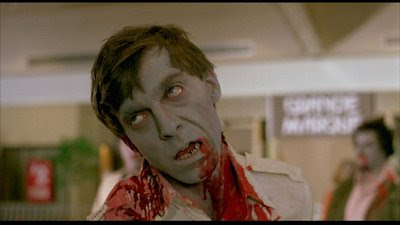
Zombie Zombie Zombie

This is a piece of work I did for a 'journal paper' at Uni, it's meant to be about genre changing over time, and how it affects the zombie film genre, I might put up some more work later, I did a really pretentious essay on Soviet Montage films, but it has a few more references.


Genre Changes and the Zombie Film


Genre changes over time, it shifts the elements that construct its narrative to make something original or it adds elements from other genres to mix the conventions the audience are used to and create new meaning, surprises and ideas.

I looked into the changes and shifts in genre that affect the zombie film genre, and how it affected the meaning of the films and where the genres took the narratives.
I tried to define the main characteristics of zombie movies that appear throughout the genre in each film. Tudor makes the point (using westerns) that: “…we must first isolate the body of films that are ‘westerns’. But they can only be isolated on the basis of the ‘principal characteristics’…”

I tried the find and define the principal characteristics of the zombie film, so mapping the genre changes and shifts would be more precise. The first and most obvious characteristic of the zombie film genre is Zombies. The Zombie is the main aspect of the genre, there are several types of zombie which I have identified from the films that I have seen and I will explain them in more detail later, I have identified several, the voodoo zombie, the undead zombie and the science zombie.

The fear of the undead is present in many different forms of fiction; stories, novels and poems all reference the dead or undead coming back from the grave to haunt the living.

”The original zombies came from witchcraft and magic, voodoo and rituals” (London, (1976) p.76) Films like Plague of the Zombies (Gilling 1966), White Zombie (Halperin, 1932) and I Walked with a Zombie (Torneur, 1943) used voodoo as the creation behind the zombie force. The Zombies were usually controlled by a voodoo priest and performed manual tasks for him, for instance in Plague of the Zombies, the zombies are used to mine tin for the “tyrannical Victorian mine owner” (London (1976) p.88).

The next incarnation of the zombie was the undead zombie. Made popular by George A. Romero’s ‘Dead’ Series, the undead zombie set the standard for the future zombies seen in television and cinema. Night of the Living Dead (Romero, 1968) was in the first in a series of five films, with more being made to this very day. These zombies were not controlled by anyone, and their only desire was to feed on living humans, adding to their own number.

After the undead zombie, the need for a more explained creation story was needed; the science zombie used scientific accidents and mistakes to explain the concept of the undead rising. This idea could be attributed to the progression of medical and experimental science in our modern age; transplant procedures and the freezing of dead bodies to be resuscitated when death and disease are not a problem seem common place today. Films like Resident Evil (Anderson, 2002), 28 Days Later (Boyle, 2002) and 28 Weeks Later (Fresendillo, 2007) all use a science aspect to explain the origin of the zombies, for instance in Resident Evil the zombies are the mistake resulting from a chemical weapons leak in an underground bunker.

The post apocalyptic society features heavily in the zombie genre; the science and undead zombie appear almost exclusively in the destroyed world as the dominant species, while human survivors struggle by. The idea of life being wiped out by an infectious outbreak was taken from Richard Matheson’s Book I am Legend (1954), which was originally a story of a vampire outbreak infecting the inhabitants of a city. More modern zombie films like 28 Days Later cite Day of the Triffids (1951) as an influence on the post apocalyptic vision of the future. Another common characteristic in zombie films is the group of survivors; each Romero film has a group of survivors struggling by against the zombie hordes, until they become complacent and kill each other off or let in the zombies, usually because of their own inadequacies and differences, rather than the zombies out witting them.


”…the zombie walks amongst us in many disguises, and he represents many of our fears.” (London (1976) p98).

Since the earliest incarnations of the Zombie film, the abilities and the causes of the undead rising from the grave have been different.
The voodoo zombies of the early films were not seen cannibalising other humans until the Romero dead series of the early 1960’s. Zombies then changed from being under the control of a voodoo priest and having an origin to being under no control and having no explanation of their origin at all. One could say that with the lack of an origin to the zombie, the films just became about gore; many of the substandard zombie b-movies that came following Night of the Living Dead’s success blatantly played on the ‘gore’ factor to attract an audience.
The gore factor has been carried through many of the incarnations of the zombie genre, many of the audience just came to see gore; the recent Grindhouse: Planet Terror (Rodriguez, 2007) used gore excessively to make up for an extremely poor story line, and the remakes of Dawn Of The Dead (Snyder) in 2004 and Day Of The Dead (Miner) in 2008 used gore a lot more than their predecessor, possibly for a modern desensitised audience, who care less about the narrative of the point it tries to make and more about the way to dispatch the monster, and the effect it has on the decorating.

One aspect between the science and undead zombie films that remains different are the zombies origins; were as the science zombie’s origins are usually explained at the beginning or in the climax of the film, the undead (particularly Romero) zombie’s origins are unexplained or just hinted at, leaving it up to the audience to decide where the monsters come from.
The science zombie is usually the result of a mistake that contaminates the whole world due to science failing, or a military weapon backfiring against its creators, where as the undead zombie contaminates the whole world, leaving figures of authority like scientists, police and army offices and elected leaders redundant and confused. Both types of zombie film comment on authority figures and their ability to deal with mass hysteria, whether it is from zombie hordes or rampaging citizens.

The zombie has been through some changes since its first incarnation in horror novels and stories. For example, Frankenstein’s monster was one of the first zombies, on screen and in literature, although he didn’t eat any living people.
The first film zombies were originally workers for a voodoo priest. A recently deceased person could be brought back from the dead by voodoo to do the priest’s bidding, usually some form of manual labour.
From Voodoo, the zombie adapted into the most recognizable form of the zombie we know today, the undead zombie. The change from Voodoo zombie to undead zombie could be attributed to the lack of religion in our modern society, or the way we view other culture’s religions. The tag line for Dawn of the Dead was “When there is no more room in hell, the dead shall walk the earth”, implying a Christian or Catholic view on the origin of the zombies without any proof. The voodoo origins of the original zombie would have been too far fetched for a modern audience.

The first undead zombie movie was Romero’s Night of the Living Dead, which was followed by the rest of the series as well as many other films which used the undead zombie as the main antagonist. There have been many variations on the undead zombie; some adaptations of the zombie have been comical, such as the films Return of the Living Dead (O’Bannon, 1985) and Peter Jackson’s Braindead (1992). Films like Shaun of the Dead (Wright, 2004) have taken a comical look at the zombie genre, but kept the zombies true to the Romero standards, poking fun at the concepts used in zombie films, rather than the zombies themselves. This could be to either revive the conventions of the zombie genre or to highlight the inadequacies of the zombie as a menace to the world; by the end of the film we are watching the zombies entertain us in stupid game shows.

Most recently zombies have adapted again into the fast moving modern zombies, probably because of the worn out conventions of the Romero-style zombie film. The modern versions share little in common with each other, apart from the fact that they are zombies.
In some instances, the zombies are faster and stronger than they’re counterparts, in the remake of Dawn of the Dead and the E4 series Dead Set (Demange, 2008), the zombies can sprint and appear more agile and stronger than their previous counterparts, again highlighting the differences and weaknesses of the Romero-style zombie and the difference of the faster modern zombies.
The adaptation of the Romero-style zombie started with 28 Days Later, although the infected are not strictly zombies, they follow the same design as some of the zombies that came before the film. In the film they are infected with ‘rage’ and they can infect others by spitting blood and by scratching or biting. They are also large in number, and choose not to attack the infected. One of the main differences to the previous zombies is the speed at which the infected from 28 Days Later move, they sprint and jump to try and attack the uninfected. The infected in 28 Days Later don’t eat the living either, the infection being carried through bodily fluids, as Christopher Ecclestone’s character Major West keeps an infected soldier tied up to see how long it will take for the infected to die from starvation.
Other modern zombie films and series include the remakes of Romero’s Dawn of the Dead and Day of the Dead. The zombies in Dawn of the Dead are much like the infected of 28 Days Later, although they eat people and are physically rotting. In Day of the Dead the zombies have gained abilities that they did not have in life let alone death, they can climb walls and jump great distances.
The E4 series Dead Set takes a zombie outbreak and sets it in the big brother household, with the housemates unaware of the zombie nation surrounding them. In this adaptation the zombies have the same abilities as the zombies in the remake of Dawn of the Dead.
The conventions of the undead/Romero-style zombie have grown old, and warrant a change to shock and scare the audience. In the fast pace modern society we live in, it makes sense that as the undead we would move just as fast as we did in life to get what we want.

The zombies in the remakes of Dawn of the Dead, Day of the Dead and Dead Set offer no explanation to why or how they have been created much like Romero’s Living Dead series. 28 Days Later offers an explanation at the beginning of the film to explain the origins of the infected, much like the ‘science’ zombie films.
The remakes of Romero’s films and Dead Set offer no explanation possibly because of the ideology present in the films subtext, Dawn of the Dead addresses issues about consumerism, Day of the Dead comments on the use of science and man playing god and Dead Set comments on the culture we have before us; reality TV and ‘celebrity culture’. The origin of our societies downfall is entirely of our own doing, rather than blaming a scientist or a voodoo priest the film states that we must point the finger inwards and blame ourselves about what we have created.

Films that use science to explain the origin of zombies became popular from the films 28 Days Later, and the computer game Resident Evil. But the first science zombie film was made in 1936; The Walking Dead (Curtiz), it was the story of a man wrongly executed for murder, who is resuscitated using electricity to claim vengeance on the real killers, only to be killed again after making the scientists responsible for his rebirth promise to never do it again. (London, (1976),p 58). The film of Resident Evil explains the origin of the zombie as a mistake from a chemical weapons factory; the zombies used to be the staff of the evil umbrella corporation of the film and games. The zombies display the same abilities and characteristics of a Romero zombie, except we know how they were created. The film also uses a large monster, called a Licker, which is a prominent ‘baddie’ in the video game. It has nothing to do with the zombie genre, and is the film only to remind the audience of the films adaptation from a computer game.
The Grindhouse production of Planet Terror also uses science zombies, but to a more comedic effect. The soldiers were infected by a gas and must constantly inhale the antidote or they become zombies.
The science zombie could be a comment on the lack of an origin story for the Romero/Undead zombie, the science zombie has a back story and origin, so it is probable that the antagonists of the film can be killed in a scientific way, giving the audience closure on the horrific nature of the film, where as the lack of origin for the undead/Romero zombie takes away the closure aspect that the audience wants by the end of the film, most of the endings of Romero films are left ambiguously, letting the audience decide the survivor’s fate.


To further explore the idea of genre changing I would investigate the other adaptations of ‘the monster’. For instance, Vampires and the changes from the first vampire films like Nosferatu (Murnau, 1922) and Dracula (Browning, 1932), to the modern versions like Twilight (Hardwicke, 2008) and Interview with a Vampire (Jordan, 1994). This could also lead into mummies and serial killers like in the Friday the 13th (Cunningham, 1980) series or the Halloween (Carpenter, 1978) series. Eventually an overview of the horror genre could be seen, the progression of the main monsters, from classical films like The Wolf Man (Waggner, 1941), and The Bride of Frankenstein (Whale, 1935) to more modern adaptations like An American Werewolf in London (Landis, 1981) and Mary Shelly’s Frankenstein (Branagh, 1994).

The limitations of this study could be the genre, although the horror genre is massive and full of many monsters, and sub genres. There is always a common denominator of a monster or bad guy, in sequels and adaptations, in other genres such as action or comedy, there wouldn’t be such a common denominator.

It would also take a lot of viewings to identify the aspects of the monster that appeared in each adaptation or sub genre, which would link them all together.

To start I would map the different types of genres from each ‘monster’, e.g. Vampire, Zombie, Werewolf etc, to get a better idea of the spread of films.

During my investigation I found that the Zombie genre has been constantly changing, much like the idea of genre itself. The zombie genre has borrowed ideas from previous films, series and video games to keep itself original and refreshing. From the original Voodoo Zombies of the 1930’s to the Science zombie of 2000, the zombie genre has been constantly changing, using different origin stories and abilities of zombies to change the genre into different sub genres.


Bibliography
Annan, D (1974) Cinefantastic: Beyond the Dream Machine: London, Lorrimer Publishing
Cook, P and Bernink, M (eds) (1999) The Cinema Book (2nd Edition), London; BFI
Gange P, (1987) The Zombies that Ate Pittsburgh: The Films of George A. Romero; New York, Dodd, Mead & Company
Jones, A (2005) The Rough Guide to Horror Movies, London; Penguin Books Ltd.
London, R ( 1976) Zombie: The Living Dead; London, Lorrimer Publishing
Lothe J, (2000) Narrative In Fiction and Film, Oxford; Oxford University Press
Marriot, J (2004) Horror Films, London; Virgin Books
Sage, V and Smith, A L (eds.) (1996) Modern Gothic: A Reader; Manchester, Manchester University Press
Tudor, A (1989) Monsters and Mad Scientists: A Cultural History of the Horror Movie; Oxford, Basil Blackwell Ltd.


Sunday, 18 January 2009

I BELIEVE IN MICKEY ROURKE

Just got back from seeing The Wrestler (Aronofsky, 2008).

I'm a big fan of Aronofsky's films anyway, films like Pi, Requiem for a Dream and the criminally underrated The Fountain really are quite beautiful, depressing and touching.
The Wrestler carries on the tradition of Aronofsky working with Clint Mansell, former guitarist of Pop Will Eat Itself, who conducts the soundtrack of the piece, minus the title song 'The Wrestler' by Bruce 'the boss' Springsteen.


The Wrestler focuses its story on the former great wrestler Randy 'The Ram' Robinson, and how he deals with his fall from grace from the heights of professional wrestling.
The opening credits sequence shows photos, flyer's and reviews of Randy's former glory, fighting against opponents in front of crowds of 20,000 people, which brings us up to present day, with a broken down Randy fighting in public halls and school auditoriums.
Lines are drawn between the 'real world' and the world of wrestling, and also between the world of stripping and the 'real world'. Randy's on/off girlfriend Cassidy/Pam, is torn between the rules of the establishment where she works and her feelings for Randy back in the real world.
The supporting cast is also fantastic, Evan Rachel Wood is the Ram's estranged daughter, Stephanie. The love interest of Cassidy/Pam is played by Marisa Tomei.


Mickey Rourke has been nominated for an Oscar for his performance as Randy 'The Ram', and is totally deserving. People might think he has been cast because of his ability to look like a wrestler, applying the muscle and training regime to make the scenes in the ring look realistic, but the limited amount of time spent in the ring only serves to amplify Rourke's performance of a once great wrestler trying to get by in the world, doing the thing that he loves most, no matter what it does to his body. The grunts and moans of pain all seem to come from the experiences of Rourke, though it's doubtful that he has ever been stapled in the chest. The moments of tenderness and love he shares with his daughter and his stripper girlfriend look lived out by Rourke. The moment at the beach with his daughter his totally moving and sums up the whole movie, again the moments between Rourke and Tomei are too few, and I for one would have loved to see more of them together discussing the err of Nirvana.

I really enjoyed The Wrestler, Rourke's performance is staggering and I might put £20 on him to win the Oscar.

Monday, 22 December 2008

My "Top Ten" Films of Two Thousand and Eight.

One of my New Years Resolutions is going to be to Blog more, so I thought I'd get a head start on January the 1st and start now.

Most people do a top ten of "......." every year, whether it's music, films, paintings.....(the list is endless), but I don't know if I can narrow down what I've seen this year to my top ten, because, thinking back, I struggle to think of a bad film I've seen this year.

So I'm just going to list my favorite films that I've seen at the cinema or bought on DVD (that came out this year), without any preference, and you can agree, or don't (but it's not your blog, so I don't care).

There Will Be Blood, Paul Thomas Anderson.

At two hours and (about) forty minutes long, this appears to be a long film. But as soon as the first shot appears (which is followed by about 20 minutes of no dialogue), it completley sucks you into the action.

The performances are quite incredible, not just from Day Lewis, but from the entire supporting cast, Paul Dano especially as the money grubbing almost insane pastor, on a mission to get as much money as possible for his 'church'.

Daniel Plainview (Day Lewis) appears to be hellbent on getting every drop of oil out of the ground, like he has a vendetta against the Earth. His adopted son H.W (Dillion Freasier and Russel Harvard) seems to be totally unphased by the lengths Plainview will go to to destroy everything that stands in his way.

The scene where Plainview smothers Eli in all coupled with the last scene are quite terrifying, not only because of the height of Day Lewis as an Actor playing a part, but because of the sheer lack of respect and ferocity Plainview expels towards Eli, a man half his size and a 'priest'.

Eli and Plainview are at odds throughout most of the film, each man believing in his own 'religion', Plainview; of wealth and riches that come from the Earth, and Eli; of faith and religion that come from the heavens. Each man is totally subscribed to what he believes in, culminating in the ending which seems totally bizarre compared to the rest of the film, but after taking time to think about what each man represents the ending seems to perfectly sum up their relationship.

Everything from first 20 minutes, the acting and he soundtrack (by Radiohead's Johnny Greenwood) to the last scene ("I SUCK IT UP SLUUUUUURP!!") is totally engrossing.

http://www.youtube.com/watch?v=ml2Ae2SIXac


WALL-E, Andrew Stanton

Who ever knew that robots could be so cute, who ever knew Disney could get so deep?

Wall-E, a little robot left on Earth to clear up our mess, after commercialization and pollution have taken over what we use to call home.
All the humans have had to go into space to make room for all the little Wall-E robots to run about and clear up what we've done to the planet.

Does sound a bit deep doesn't it?

Oh, and then he falls in love.

So, it IS a Disney film.

Wall-E is a very good animated film. The characters are well rounded and sorta cuddly, even though they're made of metal and don't really make words, more like noises that we can distinguish into what we believe they've said, which could be the appeal I suppose.
The film also tries to make a point about the pollution we cause, as well as our dependency on machines and large corporate brands for everything, and where best to put it than a Disney film?

Does anyone else think that the evil robot at the end looked a bit like HAL 9000?

http://uk.youtube.com/watch?v=UblUO0LjPUg


The Diving Bell and the Butterfly, Julian Schnabel.


If you haven't read the book, I would.

The Diving Bell and the Butterfly is based on the former Editor of Elle's book Le scaphandre et le papillon, and it chronicles his life dealing with the on set of 'Locked in Syndrome', a condition where after recovering from an initial stroke, the patient is 'locked inside' their own body, unable to move, talk and do most things we take for granted. In fact the whole book was dictated by the author Jean Dominic Bauby by blinking his left eye along to the most frequently used words in the French dialect.

Although all that sounds quite depressing, the film is quite heartfelt, especially the 'heavy breather' scene. Mathieu Arlmaric is fantastic as Bauby, although initially we don't see much of him, except through the medium of flashbacks and fantasies, much like the book, the outside world we would normally discover in leaving a room (something that Bauby was unable to do) is done through Baubys imagination and memories.

http://uk.youtube.com/watch?v=G69Zh7YIg8c


Waltz With Bashir, Ali Folman


This film kicked me in the teeth, and I loved every second of it.

Waltz with Bashir is a rotoscoping documentary film focussing on the 1982 Lebanon War, the film follows the main character Ari through his time serving in the war.

Most of the film looks and feels like a comic book, which is due to the rotoscoping (the same technique used on A Scanner Darkly) used on the individual frames of footage.

This film was a wierd one, because of the animation it felt like a completley fictional tale of comrades in a war, but in actual fact, it is just a documentary with rotoscoping done afterwards.

Looking back on the film, it is quite brilliant.
The soundtrack is bloody good too.

http://uk.youtube.com/watch?v=IKwJgOrN1f4


Cloverfield, Matt Reeves


Is it a bird? No.
Is it a plane? No.
Is it Superman?. No.

Well, what is it then?

I dunno but it looks pissed off.

Cloverfield had a massive internet buzz without actually telling us anything, which was quite clever, but at the the time, really massivley annoying.

Blair Witch meets Godzilla meets the OC in Manhattan I think could be a good way to describe what happens in the plot to Cloverfield.
I'm not being horrible about the film when I describe it like that either, the film starts with a few shots of a going away party (in a very nice flat) for the main character, Rob, who is going to Japan to be Vice-President of a big company.
After the many different shots by Hud (the cameraman for most of the film) of people wishing Rob well the action begins.

Of course the first reaction is 'is it terrorists??' was one of the main selling points of the film I believe.
Massive 'attack' in a downtown surburban American enviroment.

The film is very good despite its OC-esque start, but even that serves a purpose, especially the blossoming relationship of Hud and Marlena.

Until she explodes. Chin up man, happens to the best of us.

The characters have a background and I certainly cared when one of them was crushed or went missing or exploded (actually, I was gutted about that one).

But, overall I really enjoyed Cloverfield, even with the exploding ness of girl.

http://uk.youtube.com/watch?v=IvNkGm8mxiM


Other films that I have enjoyed this year but don't want to write anything about because they've been done to death (sorry for the pun) already have been:


The Dark Knight, Christopher Nolan

No Country For Old Men, The Coen Brothers


Films that I am looking forward to in two thousand and nine:

The Wrestler, Darren Aronofsky.

Revolutionary Road, Sam Mendes.

Star Trek, JJ Abrahams.

Valkyrie, Bryan Singer.

The Curious Case Of Benjamin Button, David Fincher.

Watchmen, Zak Snyder.

X-Men Origins: Wolverine, Gavin Hood.

Terminator Salvation, McG.

Harry Potter and the Half Blood Prince, David Yates.

The Wolf Man, Joe Johnston.

Che, Steven Soderbergh.

The Fantastic Mr. Fox, Wes Anderson.


Wednesday, 3 December 2008

The final shot made me think of westerns though.....

I haven't posted anything for a while really, or yet, to be more precise.
Haven't really had much to say to be honest.


I went to see Changeling today (2008, Eastwood), it was pretty good.
It did get a little bit darker than what I was expecting though, especially the whole "one flew over the cuckoos nest" section of the film, which didn't seem out of place, but didn't seem to fit in place either.
The performances on the whole were pretty good, especially John Malkovich (but he's good in most things really; i.e, Con Air). Although I thought Angelina Jolie in the lead role was a little strange, I mean, she's good in it, but it just seems a bit odd that a mother who has adopted 10-12 (I don't really follow these kinds of things) would play someone in a film who has so much trouble taking care of another random child, although she is pretty good as the main character.

The final shot made me think of westerns though.....


All in all, a pretty decent film.


http://www.youtube.com/watch?v=_Gki4gmYx10